
The Ask
When In-Person Becomes a Differentiator, Not a Drawback
While competitors raced to offer maximum flexibility with online options, extended timelines, and asynchronous learning, the University of Richmond remained committed to its in-person, cohort-based MBA. The challenge wasn’t whether to abandon that model, but how to position it as a strategic advantage.
Richmond needed messaging that would resonate with ROI-driven professionals demanding proof. The program had strong outcomes and an invested faculty, but these strengths weren’t breaking through or reaching the desired audience.
What We Did:
- Research & Discovery
- Persona Development
- Brand Voice & Messaging Framework
- Landing Page Messaging
- Digital Ad Campaign
Strategic Approach
Research: Understanding Why Prospects Say No& Employers Say Yes
We interviewed non-matriculants to uncover a critical insight: the primary barrier wasn’t the in-person format. It was the lack of transparent outcome data. In our interviews with hiring managers, they essentially were not aware that Richmond had an MBA. We learned that institutional prestige and academic reputation do not automatically translate to employer awareness.
Our research revealed The ROI-Driven Pivot persona: fiscally rational career changers who needed defensible proof before investing but that prioritized a full experience. They wanted salary progression, career advancement examples, and clear evidence of measurable returns.
We also discovered Richmond’s visual and verbal identity felt too quiet, too similar to undergraduate messaging. It lacked the polish expected by professionals evaluating C-suite advancement.
We talked to two important groups for the Richmond MBA to understand the brand perception from both prospective students and corporate hiring manager. Additionally, we wanted to get to the bottom of why students who were accepted ultimately said no.
Admitted students who didn’t enroll told us the in-person format wasn’t the issue — they just couldn’t find proof that the degree was worth it. They wanted to see real salary numbers, career trajectories, and concrete examples of where Richmond MBAs had landed. Without that, the investment felt too risky. We came to think of this audience as career changers who are financially cautious but want the full experience — they just need the evidence first.
Hiring managers surfaced a different problem. Most of them didn’t know Richmond had an MBA program at all. Having a strong academic reputation, it turns out, doesn’t mean employers are paying attention.
Research: Understanding Why Prospects Say No& Employers Say Yes
We interviewed non-matriculants to uncover a critical insight: the primary barrier wasn’t the in-person format. It was the lack of transparent outcome data. In our interviews with hiring managers, they essentially were not aware that Richmond had an MBA. We learned that institutional prestige and academic reputation do not automatically translate to employer awareness.
Our research revealed The ROI-Driven Pivot persona: fiscally rational career changers who needed defensible proof before investing but that prioritized a full experience. They wanted salary progression, career advancement examples, and clear evidence of measurable returns.
We also discovered Richmond’s visual and verbal identity felt too quiet, too similar to undergraduate messaging. It lacked the polish expected by professionals evaluating C-suite advancement.
We talked to two important groups for the Richmond MBA to understand the brand perception from both prospective students and corporate hiring manager. Additionally, we wanted to get to the bottom of why students who were accepted ultimately said no.
Admitted students who didn’t enroll told us the in-person format wasn’t the issue — they just couldn’t find proof that the degree was worth it. They wanted to see real salary numbers, career trajectories, and concrete examples of where Richmond MBAs had landed. Without that, the investment felt too risky. We came to think of this audience as career changers who are financially cautious but want the full experience — they just need the evidence first.
Hiring managers surfaced a different problem. Most of them didn’t know Richmond had an MBA program at all. Having a strong academic reputation, it turns out, doesn’t mean employers are paying attention.
Both groups pointed to the same gap: Richmond’s look and tone felt more like undergraduate marketing than something aimed at working professionals weighing a major career move.
Brand Voice Development
From Program to Investment
We developed a brand voice that spoke directly to accomplished professionals who think in returns. Measured, direct, and personal.
Core Voice: Serious advancement, made personal and measurable.
The Big Shift:
| Before | After |
| A program | An investment |
| In-person format | Strategic advantage |
| Faculty availability | Career partnership |
| General outcomes | Defensible ROI |
The voice assumes the reader is already accomplished and motivated. It doesn’t need to convince them to pursue an MBA. It needs to prove why Richmond is the rational choice.
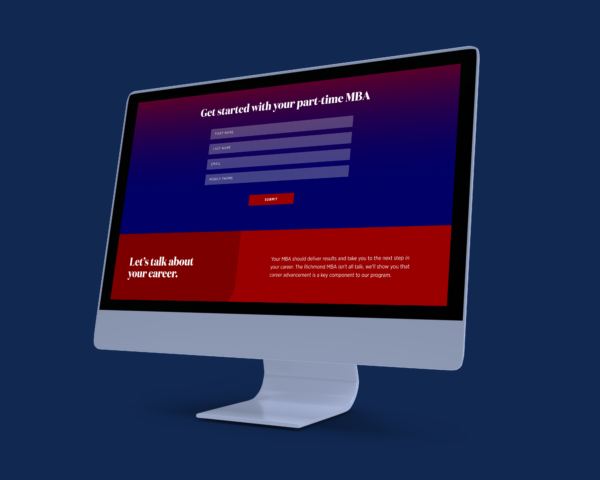
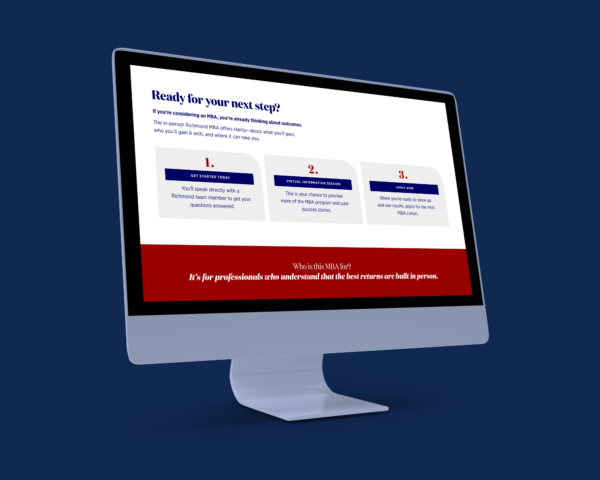
Landing Page Strategy
Leading with Outcomes, Not Features
Rather than burying ROI data, we led with it. The first major content section: “Outcomes that move you forward. This is not about potential. It’s about what happens next.”
We structured the page to establish credibility immediately, then introduce the human elements. The cohort connections, faculty mentorship, immediate application are seen as the competitive advantages they are.

Digital Ad Development
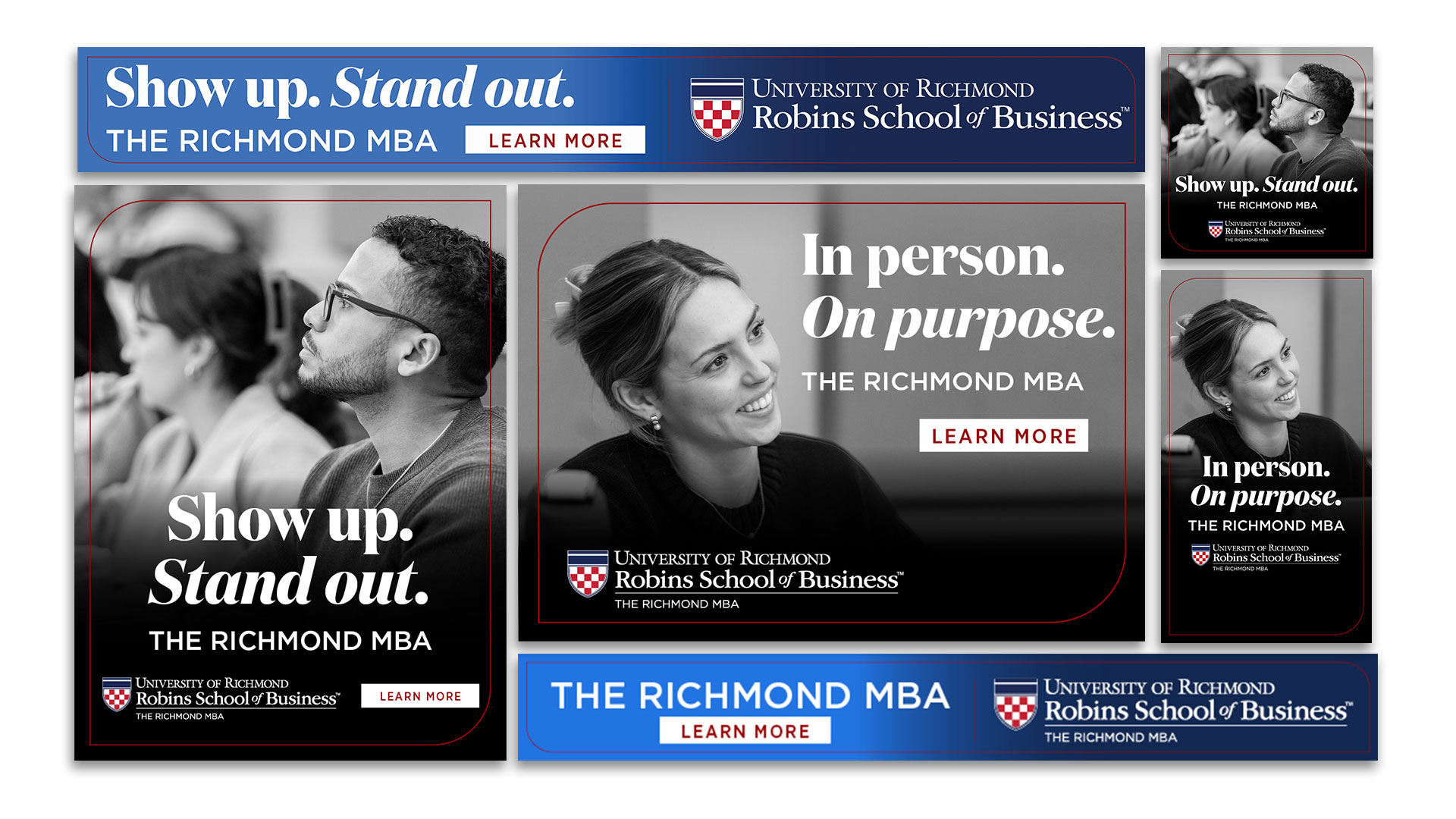
We developed punchy, confident headlines across three categories:
ROI-Focused: “Small Rooms. Big Returns.” | “Proof First. Promises Second.”
Program Positioning: “Part-time. Full MBA experience.” | “The Richmond MBA: In Person. By Design.”
Connection as Leverage: “Ambition thrives in good company.” | “Where connection becomes leverage.”
The Result
Repositioning In-Person as a Strategic Advantage
We delivered a complete messaging framework that transformed Richmond’s positioning. The work shifted Richmond’s marketing from feature-focused to outcome-focused, giving them the language to compete confidently in a market where everyone claims transformation, but few can prove it.
In a market racing toward flexibility, Richmond now owns a different position: the MBA for professionals who understand that proximity, partnership, and proven outcomes matter more than maximum convenience.
The messaging doesn’t just describe the program, it makes the case for why in-person, cohort-based learning is the smarter investment for serious career advancement.