
Seeking a Fractional CMO? An Agency Might Be Your Best Hire
Key Takeaways
- Marketing is a whole-brain effort. The analytical side sets direction, and the creative side turns that direction into work people remember.
- An agency serving as a fractional CMO brings both sides together, pairing senior strategic leadership with a full bench of specialists.
- Ownership is strongest when the team that recommends the plan also carries it out.
- Agencies stay accountable by building trust into the structure. Shortfalls are reported honestly, recommendations aren’t tied to spend, and the data stays in your name.
- Leadership alignment gives every decision a shared definition of success, so work keeps moving once it begins.
- Agreeing on boundaries of action up front gives a team room to adjust quickly as data comes in.
- The model fits mid-size organizations in construction, trucking, financial services, higher ed, and nonprofits that need senior leadership without the cost and commitment of an executive hire.
- A fractional model scales with your goals, with a fixed monthly rate and the ability to add services as priorities shift.
More organizations are rethinking what marketing leadership looks like. For years, the standard approach was to hire a full-time Chief Marketing Officer (CMO) and grow an internal team over time. Today, leadership groups have another well-regarded choice: partnering with a marketing agency that steps into the CMO role on a fractional basis, bringing senior strategy and a full bench of specialists in a single relationship.
Why? In many organizations, a traditional CMO leads strategy while budget, creative alignment, and production sit with other teams. The specialists who carry out the plan are brought on over time, and each of those connections is a place where momentum can slow down. With so many hands involved, it can become unclear who is ultimately in charge of the outcome, and when ownership is shared by everyone, decisions can wait for someone to make them.
An agency serving as a fractional CMO brings those pieces into one team. Strategy, creative, and production work side by side, with goals and reporting agreed upon up front, so everyone knows who owns the outcome. The result is a shorter path from what you know (a.k.a. marketing research answers and business objectives) to what you do (a.k.a. marketing execution and results).
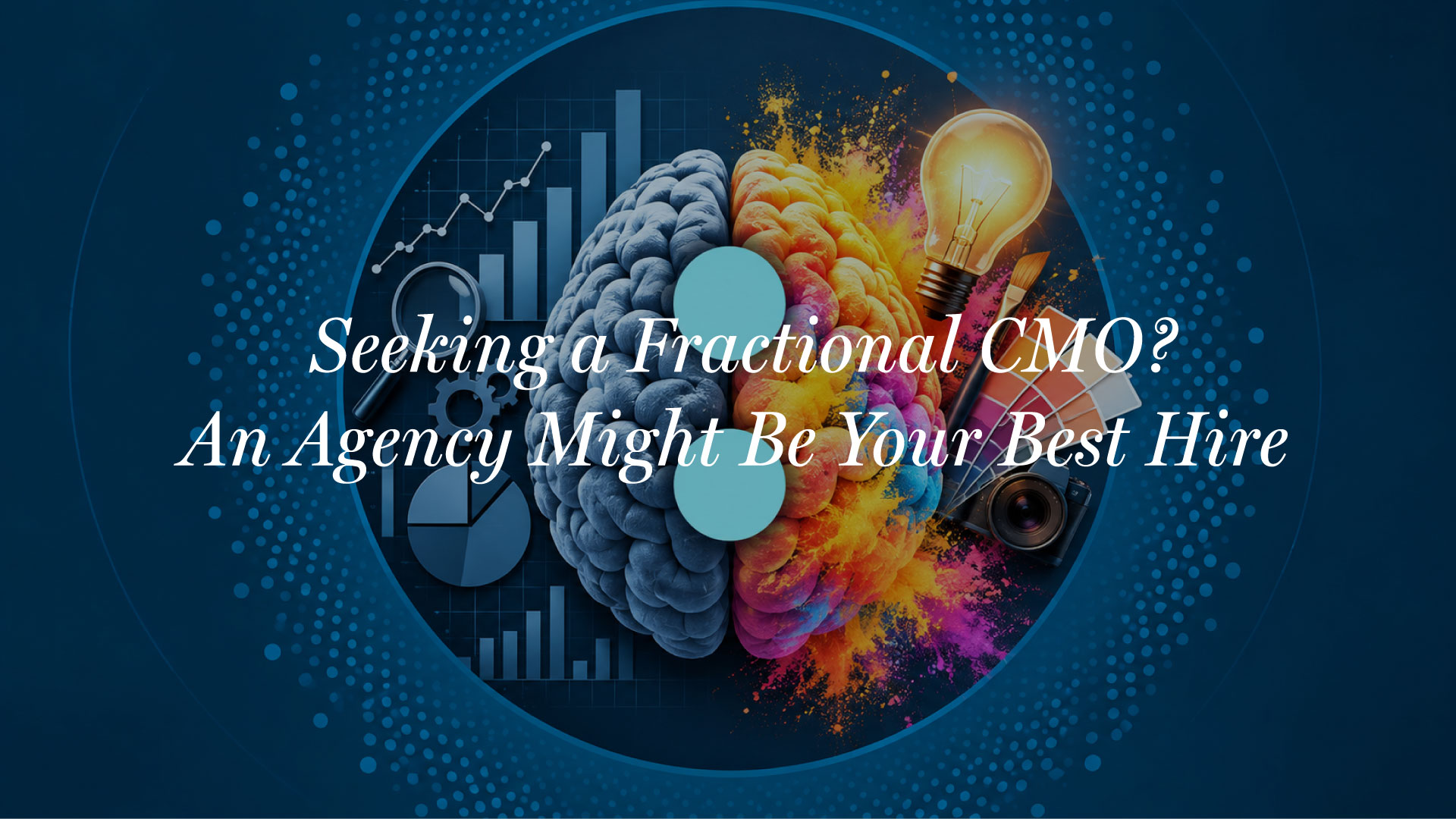
Marketing has two sides, much like the brain itself. The analytical side compiles the revenue, pipeline, margins, and market data. The creative side brings the ideas that make an audience stop, feel something, and act. The strongest marketing draws on both, and that’s worth keeping in mind for any leadership team deciding who should lead it.
This post explores how an agency serving as a fractional CMO connects both sides of the brain, and why that pairing gives leadership teams a strong foundation for turning insight into action.
Three Ways to Lead Marketing
In-house CMO vs. Agency as Fractional CMO vs. Traditional Agency
Most organizations organize marketing leadership in one of three ways, and each brings its own strengths. An in-house CMO brings a panoramic view of the business, which is invaluable for steering a company. A traditional agency brings deep craft in the channels, which is invaluable for producing results. An agency serving as a fractional CMO brings both perspectives to the same table. It connects channel-level performance to the goals on the leadership team’s dashboard, so every click, lead, and impression points back to something the company cares about.
A Side-by-Side Look at Each Model
| In-House CMO | Agency as Fractional CMO | Traditional Agency | |
| Primary Role | Individual who leads marketing strategy as a full-time executive | Team that leads marketing strategy and carries it into execution | Team that executes assigned work within specific channels |
| Strategic View | Business-wide, from inside the organization | Business-wide, informed by work across many industries | Focused on the channels or projects in scope |
| Execution | Directs internal teams and outside vendors | Handled by the same team that sets the strategy | Core strength, guided by direction from the client |
| Expertise | One leader’s experience, plus the team they build | A bench of specialists across strategy, creative, media, and digital | Specialists in the agency’s areas of focus |
| Organizational Knowledge | Deep and ongoing, embedded in daily operations | Built through discovery, research, and regular collaboration | Built around the projects in scope |
| Accountability | Shared across departments, vendors, and budgets | One team under one agreement, measured against objectives set up front | Tied to deliverables within the assigned scope |
| Cost Structure | Full-time salary, benefits, recruiting, and onboarding | Often a monthly retainer, scaled to the scope needed | Shorter, once scope is defined |
| Time to Get Started | Longer, depending on search, onboarding, and team building | Shorter, with a team already in place | Shorter, once scope is defined |
| Flexibility | Changes in scope often mean changes in headcount | Scales up or down as priorities shift | Scales within the services offered |
| Best When | The organization can support a full department and needs a leader embedded day to day | Leadership wants senior strategy and execution together without building a full department itself | Strategy is already set and the team needs channel-specific support |
Ownership Thrives When Strategy and Execution Share a Home
A marketing leader is best positioned to own an outcome when they also hold the inputs that shape it. Those inputs include the strategy, the budget conversation, the alignment with leadership, and the production of the work. Organizations that bring these pieces together tend to see accountability come naturally.
Agencies are built around this kind of ownership. Our fractional CMO work at Frankel covers the execution and everything that comes before it. Audience research and clearly defined goals feed directly into our strategy, and that strategy tells us exactly what to execute. From there, we focus our efforts on a plan the whole team is aligned around, such as converting a target number of qualified leads each month, and we report on those objectives just as we proposed them.
An agency also brings a fresh perspective, grounded in data. Every organization has a history and a way of doing things, and that is valuable context to begin with. Research adds a second layer. What do your audiences believe today? Where is your market heading? Which strengths are ready to be put forward?
Starting from those insights gives the agency a North Star to return to whenever a decision comes up, and gives the creative team a clear, current picture to build on, so ideas begin with what’s true now and carry the organization’s story forward.
How Frankel Keeps Strategy Accountable
It’s the first question a careful leadership team should ask. If the same partner recommends the plan and carries it out, what keeps the recommendations honest? The goals and reporting agreed on at the start are part of the answer, but trust needs a few more safeguards built in.
- Shortfalls get reported, too. If a number misses its target, it shows up in the report alongside what we learned and what we’d change. We don’t swap in a more flattering metric midstream.
- Recommendations aren’t tied to spend. When a channel underperforms, our job is to say so and move the budget, even if that means producing less of the work we’d otherwise be paid to make.
- You own the data. Ad accounts, analytics, and those live dashboards sit in your organization’s name, so your team sees every number we see.
- The partnership has to earn its renewal. Scheduled strategy reviews give leadership a standing moment to question the plan, redirect investment, or change the scope, and that’s a healthy pressure for any partner to work under.
Alignment Gives Execution Its Momentum
Marketing moves fastest when a leadership team is aligned. That means a shared definition of success, a common view of priorities, and an honest understanding of the trade-offs along the way. When those pieces are in place, the clarity travels downward. Leadership knows which direction to pursue, the teams doing the work move with confidence, and decisions are made once and stay made.
Frankel builds that alignment into the start of every client engagement. Our discovery phase brings together the people who will shape and approve the work, and it almost always surfaces something valuable, whether a conviction the audience shares or a strength that has been underplayed.
Among our research services, we also include stakeholder alignment, message and creative testing, and competitive audits, giving leadership a shared set of facts to rally around. Because we validate before we build, a campaign begins with a team that agrees on what success looks like and why. That shared starting point lets the work move forward with very few pauses for second-guessing. It also gives project management a natural role, keeping timelines on track, guiding budgets toward what matters most, and making every dollar and every week count.
Setting the Boundaries of Action
Once a team is aligned, the next step is agreeing on how much room it has to move. The most responsive marketing teams decide on their parameters early. Leadership and the agency decide together what’s flexible and what’s fixed, and then the people closest to the data can act without waiting on approvals. Timelines and budgets stay steady, and the team can still respond quickly when the data points somewhere new.
In practice, this often takes shape through four simple structures:
- Pre-authorized pivot buffers. A set amount of budget and time the team can redirect when the data points to a stronger channel or message.
- Brand guardrail matrices. A clear map of what can flex, what stays fixed, and who decides, so creative choices move along smoothly.
- Cross-functional squads. Strategists, writers, designers, and media specialists working together as a single team.
- Live dashboards. Shared, real-time results, so leadership and the team see the same picture and can talk about what’s next as soon as the data arrives.
This approach gives leadership confidence that the work stays on budget and on goal, and it gives the team the freedom to respond to what the audience is telling them in the moment.
When an Agency Fractional CMO is a Better Choice
An agency as the fractional CMO suits a wide range of organizations, and a few situations bring out its strengths in particular.
Leadership and production are both needed. An agency offers immediate access to copywriters, graphic designers, SEO specialists, media buyers, and web developers working alongside strategic direction. There is no need to hire each role separately, so campaigns can begin producing sooner.
Budgets are focused on results. A full-time CMO is typically a six-figure investment before a single supporting team member joins. Directing that same investment toward a partner that provides both strategy and output puts more of it into the work itself, and into leads, traffic, and creative that can be measured.
Needs shift through the year. Agency support can grow for a product launch or seasonal push and settle back afterward, giving organizations a flexible way to match capacity to the moment.
The landscape keeps changing. Agencies work across many accounts every day, so they tend to be among the first to notice platform updates, algorithm changes, and emerging tools. That knowledge goes to work for every client they serve.
Industries That Benefit From an Agency Fractional CMO
The model works best for organizations that have outgrown ad hoc marketing but don’t need, or aren’t ready for, a full executive hire. We see it most often in:
Mid-size construction firms, where marketing has traditionally lived with business development or ownership, and growth now calls for a real brand and a steady pipeline.
Trucking and transportation companies, often competing for drivers and customers at the same time with a lean marketing team, or none at all.
Financial services firms, from regional banks to wealth management groups and lenders, where compliance requirements make experienced, consistent leadership especially valuable.
Higher education institutions in transition, whether that’s a new president, enrollment pressure, a rebrand, or a marketing office of two or three people carrying a university-sized workload.
Nonprofits that need professional-grade strategy and creative but can’t justify an executive salary over mission spending.
A full-time executive hire is a long-term commitment, and a costly one to undo if the fit isn’t right. A fractional partnership gives these organizations a predictable monthly investment, tied to goals leadership agreed on, with the flexibility to scale up or down as priorities shift.
Let Insight Lead the Way
Insight, strategy, and production work best when they share one home. The research informs the plan, the plan guides the work, and the results feed the next round of learning, all inside a single team that has a stake in the outcome.
Frankel leads marketing across industries, from higher ed and financial services to trucking and construction. Our perspective as your CMO doesn’t come from one sector’s playbook. An approach that moves prospective students can sharpen a driver recruitment campaign. A trust-building strategy from wealth management can strengthen a capital campaign. That cross-pollination is something a single-industry specialist can’t bring to the table.
For leadership groups ready to turn what they know into what they do, allow Frankel to help you along the way. We’re our clients’ strategic communications and marketing partner, operating as a fractional CMO. Meaning we bring the senior-level strategy, full-service support, and creative execution all together to help organizations close the distance between the value they deliver and the value their audiences perceive.
Whether you’re looking to align your leadership team around a shared strategy, bring a full bench of specialists to your next campaign, or give your research a clear path to action, we can create communications that feel true to your brand.
Ready for a partner who can lead and deliver? Let’s talk about what a fractional CMO relationship could look like for you.
FAQs
What is a fractional CMO?
A fractional CMO is a senior marketing leader who provides chief marketing officer-level strategy on a part-time or contracted basis. When an agency fills the role, leadership gets that strategic direction plus a team of specialists ready to put the plan into action, all under one agreement.
How much does a fractional CMO cost?
The cost of a fractional CMO depends on scope: how much strategic leadership you need, whether execution is included, and how long the engagement runs. For many organizations, it represents a smaller, more predictable investment than a full-time executive’s salary, benefits, recruiting and onboarding, plus the team that leader would need to build. To learn more about Frankel’s rates, according to your specific project’s scope, we recommend reaching out for a consultation.
What is the difference between a fractional CMO and a marketing agency?
A traditional marketing agency typically executes work within channels it’s been assigned, while a fractional CMO owns the overall strategy and business-wide view. An agency serving as your fractional CMO combines both, connecting the big-picture plan to the creative, media, and digital work that brings it to life.
What are the benefits of hiring an agency as a fractional CMO?
The biggest benefit of hiring an agency as a fractional CMO is that strategy and execution share a home, so insight moves into action without losing context in the handoff. Leadership teams also gain a bench of specialists, a perspective shaped by work across many industries, the flexibility to scale up or down, and one clear point of accountability.
How long does a fractional CMO engagement last?
Engagements vary based on an organization’s needs. Many fractional CMO relationships are structured as a monthly retainer, which gives leadership consistent strategic support and a predictable investment. Some organizations bring in a fractional CMO through a transition or growth phase, while others keep the relationship in place as their long-term marketing leadership.
When is an in-house CMO better?
An in-house CMO is often the better choice when an organization is large enough to support a full marketing department and needs a leader embedded in its culture day-to-day. Companies where marketing is deeply tied to daily operations, or that are building a long-term internal team, may benefit most from a full-time hire.