

Alumni Engagement in Higher Education is More Than Fundraising
Key Takeaways
- Many institutions treat alumni engagement as a fundraising input. It’s more useful to treat it as the underlying asset that supports fundraising, enrollment, and reputation at the same time.
- Engaged alumni are a leading indicator of institutional health. Connection tends to move before giving does, which makes engagement an early signal of how well the institution is doing.
- Alumni are among your most credible brand ambassadors. As public confidence in higher education softens, a graduate’s word tends to carry further with prospective families than institution-authored messaging.
- The advantage of alumni engagement beyond the ask has multiple benefits. One engaged alum can influence a prospective student, contribute to peer perception, and model participation for other graduates, so the return often surfaces outside the advancement ledger.
- Unlocking that leverage is a marketing and strategy discipline. It takes audience research, a durable brand, and storytelling that treats alumni as partners rather than prospects, which is the work we focus on at Frankel.
Your advancement office doesn’t need to be told that alumni are central to its future. By almost any measure, institutions have gotten good at the alumni relationship they’ve chosen to optimize—giving.
And it shows. In FY2025, alumni accounted for 23.2% of all funds raised by colleges and universities, according to the Council for Advancement and Support of Education (CASE). Alumni are, unquestionably, one of higher education’s most valuable financial constituencies.
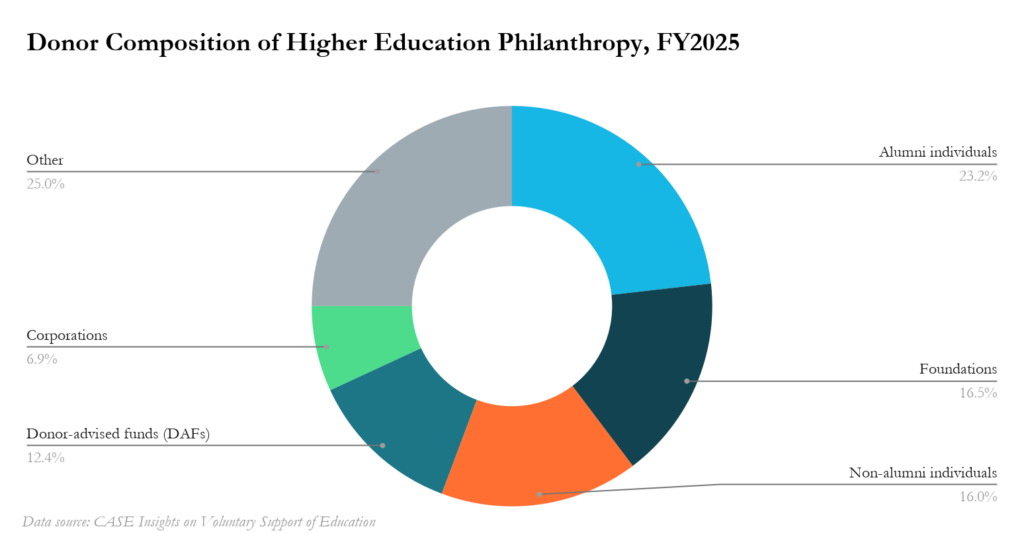
But that number describes how well institutions have optimized for the ask. It says almost nothing about the health of the relationship underneath it. And when you look at the relationship itself, a different picture emerges.
The data suggests there is an institution-alum relationship problem.
- 40% of alumni feel disconnected from their institution, while nearly half (48%) feel ill-informed about what it is doing. (The National Alumni Survey, 2026)
- 68% of alumni give charitably to some nonprofit, but only 20% rank their alma mater as a top charitable priority. (RNL National Alumni Survey, 2024)
- 72% of alumni report solicitation fatigue, and 68% say they are asked to donate too often, according to recent alumni-engagement data. (CASE Voluntary Support of Education Alumni Giving Insights, 2023)
There’s a pattern here. We know people give to organizations they feel connected to, believe in, and understand. But a large share of alumni feel none of those things toward their alma maters. Instead, they feel disconnected, uninformed, and, when they do hear from their alma mater, it comes across as spam.
That suggests the problem may not be alumni willingness to engage. It may be what institutions are measuring, and, as a result, what they are building the relationship around.
When giving is the clearest measure of alumni engagement, it’s easy for everything else to become secondary. Think about the alum who refers prospective students to your university. The graduate who hires interns at their Fortune 500 company. The alum who shows up as a volunteer and mentor, stays informed, and continues to advocate for the institution.
Those relationships are producing value, too. The problem is that much of this value is underused.
Why a Donor-only Strategy Leaves Value on the Table
For a long time, giving was the clearest measure of alumni engagement. A gift was an action the institution could track, a value it could quantify, and an outcome it could report.
But when giving becomes the primary measure of engagement, it can also become the primary way institutions think about the relationship.
If an alum isn’t being evaluated as a potential donor, they may receive fewer opportunities to participate in other meaningful ways. The graduate who could mentor students may never be asked. The alum with deep connections in an industry may never be tapped. The parent who is proud of the institution and eager to refer a prospective student may never have a clear way to do it.
And if those interactions aren’t being captured, the institution may not even know what it’s missing. That’s part of why CASE introduced its Alumni Engagement Metrics in 2019, expanding measurement beyond philanthropy to include volunteerism, experiential engagement, and communications. The shift uncovered that alumni feel more compelled to give philanthropically to their institutions when they’re engaged in other ways.
To widen the aperture of alumni engagement, institutions can ask “Who wants to help, where can they make a difference, and what would make them want to stay connected?” Those questions could lead to a much larger view of the alumni relationship, and a much larger opportunity for the institution.
Why Alumni Engagement Is a Leading Indicator of Institutional Health
Alumni engagement can tell an institution whether its relationship with alumni is still relevant, and it can lead to better decisions.
- Are we communicating the things alumni actually care about?
- Are we showing them what their degree and institution are doing in the world now?
- Are we creating relevant ways for them to participate?
- Are we making it easy for them to see where their experience, expertise, or support can matter?
In that sense, alumni engagement can function as an early signal (but not a definitive measure) of how effectively an institution is maintaining one of its most important long-term relationships.
When engagement is strong, institutions have more opportunities to understand what resonates, where alumni want to contribute, and where the relationship can grow. When it declines, that can be a reason to look more closely at what alumni are, or aren’t, getting from the relationship.
Every alumni engagement is a KPI used as a source of insight, so institutions can make smarter decisions about how they communicate, where they create opportunities, and how they build relationships that last.
Three Returns of Alumni Engagement
When alumni engagement is baked into the relationship, the return adds up in other ways for the institution. We see three distinct returns: stronger enrollment, stronger career outcomes and a stronger reputation.
Alumni Can Strengthen Enrollment
Prospective students and families want to know what life after college actually looks like. An alum can answer that question with a stronger air of credibility.
They can talk about a professor who changed their career. Explain what they learned outside the classroom. Share how the institution helped them get their first job. Tell a prospective student what they wish they had known as a freshman. Those stories turn institutional promises into lived evidence.
Alumni can also become a direct part of the student experience. Only 12% of students say they feel they totally belong at their college or university, according to Salesforce research, and opportunities to connect with industry representatives and alumni rank among the factors students identify as helping build that sense of belonging.
Engagement, in other words, does not have to begin after graduation. The alumni relationship can reinforce the student experience long before someone becomes an alum.
Alumni Can Strengthen Career Outcomes
Your alumni network is also an institutional resource. Graduates become managers, founders, recruiters, entrepreneurs, physicians, educators, nonprofit leaders and community leaders. They create professional networks that students can access.
And many alumni want to give future students the same kind of starting point the institution once gave them. They want to help open doors, share what they’ve learned and make the path a little easier for the next generation. But they need opportunities to see where they can make that difference.
In fact, 85% of alumni agree they would donate more often if they knew their money was funding organizations or initiatives with which they had been involved as students.
That same sense of connection can extend far beyond giving. Alumni can offer mentorship, internships, interviews, introductions and career advice. They can hire graduates and recommend them to others. And in the process, they get a chance to give the next generation some of the same opportunities their own education gave them.
Alumni Can Strengthen Reputation
Perhaps most importantly, alumni can carry their experience into workplaces, communities, professional networks, and conversations with prospective students and families. When they feel connected to the institution, they can reinforce what the brand stands for through their own experiences and relationships.
A graduate sharing how a professor shaped their career, an alum recommending the university to a colleague or a former student speaking with a prospective family all add dimension to the institution’s brand story.
When a graduate tells a prospective student, “I wouldn’t be where I am without this place,” that lands differently from proof of concept than an admissions campaign about the type of program offerings.
A well-engaged alumni community becomes a distributed reputation network for the institution—one that can influence enrollment, employer perception and institutional standing without the university always being the only one doing the talking.
What Does Meaningful Alumni Engagement Actually Look Like?
Meaningful alumni engagement is not simply sending more emails or hosting more events. It is giving alumni reasons to stay connected that have value whether or not a fundraising appeal is attached.
That starts with giving before asking. Think about offering the following:
- Career resources
- Access to research
- Continuing education
- Professional networking
- Mentorship opportunities
- Invitations to participate in the student experience
- Connections to other alumni
When an alum consistently receives value from the institution, a request for support feels less like an interruption and more like a natural part of an ongoing relationship.
It also means communicating with alumni throughout the year versus solely throughout a seasonal campaign run. That does not necessarily mean more communication, but more relevant communication.
For example, an alum in Atlanta who works in healthcare would not necessarily receive the same messages as a recent graduate living across the country. Interests, geography, industry, life stage, and past involvement can all shape what is relevant to your alumni lists.
The goal is to make alumni feel known and have a stake in the institution. Often, the very behaviors that keep the relationship active see better donor participation rates. As reported by CASE, institutions with strong alumni engagement programs see up to 40% higher donor participation rates than those without structured engagement strategies.
Are You Giving Alumni a Reason to Engage?
Think about the alumni you already have. Somewhere in that database is a graduate who would happily mentor a student or vouch for your institution in a room where no one from campus is present. A lot of them are just waiting to be asked.
So maybe the question worth sitting with isn’t how to get more from your alumni. It’s whether you’re giving them enough to stay connected in the first place, and whether, when you finally do reach out, you’ve earned the kind of relationship that makes them glad to hear from you.
That’s the work we care about at Frankel. We’re a higher education-focused strategic communications and marketing firm, and we help colleges and universities build these relationships through audience research, brand strategy, creative storytelling, and integrated marketing campaigns designed specifically for higher education.
We’ve helped institutions, including the University of Richmond Advancement, build a campaign architecture around what alumni care about to turn those relationships into more meaningful, ongoing engagement.
Whether you’re looking to re-engage lapsed alumni, increase participation, or build a stronger long-term engagement strategy, we create communications that feel true to your institution.
Let’s work together to build an alumni engagement strategy that earns the right to ask.